
Crawling, Creeping and Walking
- Samuel Stewart
- Feb 14
- 4 min read

Coach 1: “They are doing a bear crawl, right?”
Coach 2: “No, they are doing a forward and back creep.”
Coach 1: “We call that a bear crawl”
Coach 2: “Well, it’s not a bear crawl, for one, their lumbar spine is in extension, and two bears walk, they don’t crawl”
Coach 1: “Everyone calls it a bear crawl”
Coach 2: “People are wrong all the time”
Coach 2: – self thought “But why the hell do I call it a creep?”

A conversation like this prompted me to review how and why I describe crawling and quadrupedal movement patterns the way I do, and what I could be doing better. Let’s not waste any time and start upsetting some people straight away by talking about things we could be doing better and things you are probably doing wrong.

We often see the term quadruped used to describe the position below; it is also often called a four-point position. Four-point is fundamentally flawed because there are actually six points of contact with the ground. While "quadruped" simply refers to having four limbs in contact with the ground, it is not, by definition, incorrect and could, in fact, be used to accurately describe positions such as a front plank, a push-up, or a tabletop position. Therefore, we can still use the term quadruped for stationary movements, but may benefit from being more specific, such as two-, three-, four- or six-point quadruped. The same can not necessarily be said for crawling variations, and this is where I think we really need a more accurate system for describing exercises.

The common definition of crawling is movement on your hands and knees or by dragging the body close to the ground. In pediatric movement descriptions, crawling is typically defined as movement with the body still on the ground, and creeping is what most people would call a crawl. Therefore, any quadrupedal movement with the knees off the floor should not be referred to as a crawl, and any movement with the trunk off the floor is not a crawl. Even the phrase creepy crawly – refers to insects that utilise either a creep or a crawl to move.

The leopard crawl used by the military is the perfect example of a true crawl.

Quadrupedalism is a form of terrestrial locomotion in animals using four limbs. Therefore, quadrupedal is accurate descriptor of the type of locomotion typically labelled as a creel or a crawl for exercise prescription.
Overall, I am still in favour of using descriptive terms such as animal names that mimic the type of locomotion we are prescribing, such as dragon/lizard walk, bear walk (not crawl), inchworm or caterpillar walk. It makes more sense to clients, is more fun, and overall sounds less wanky. That said, we need to use accurate and appropriate language when describing these motions to each other, at the very least, and we should use terms such as crawl, creep, or walk appropriately.

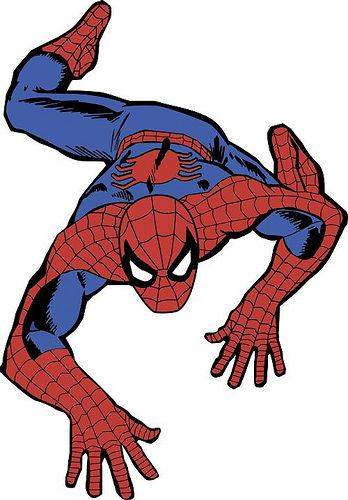
The Spiderman crawl is a good example of the exercise that, although well-known thanks to the popularity of Spiderman, most people understand the reference despite the inaccuracy of its name. It is not a true crawl. Therefore, something such as a “quadrupedal walk with ipsilateral knee to elbow and trunk close to the floor” is a more accurate descriptor of the exercise. That said, I am sure we all agree that Spiderman crawl sounds much better
I still believe there is value in these more accurate descriptors, as there is too much variety in how to interpret something like a bear crawl, which is, by name, an inaccurate description. We all usually develop our own coaching nuances over time, and there are variations to exercises that we have to describe in one way or another. However, if an exercise requires a detailed explanation from another coach just to understand what exercise you are doing, the most likely explanation is that we are not using a consistent system for describing particular movements. For example, if you say rear foot elevated split squat or Bulgarian split squat, there shouldn’t be much confusion about the exercise. Nevertheless, the posture length, shin angle, pelvis angle, trunk angle, loading method, and tempo could all be altered depending on the specific purpose for which the exercise was selected. Whereas a bear crawl could easily get you a few completely different exercises, and an inchworm may just get you some confused faces.
The crocodile or alligator walk, depending on your country, is another good example of an exercise name with various interpretations. Truly, a crocodile doesn’t move any differently from most lizards, so it is more often used to describe walking on the hands in a push-up position with the feet on a slider. Again, the name sounds better than ‘quadrupedal walking on hands with feet on a slider and straight arms. Nonetheless, it is important to consider that these reptiles do crawl as well, so there is, if nothing else, merit in being pedantic about whether to call it a crawl or a walk.

We are just ignoring the fact that most reptiles have a fifth point of contact with their tail when walking, mostly because we don’t have tails.
Why shouldn’t I just call it a bear crawl? Do you actually have a point?


I do not propose the above table as a complete solution to this problem, nor do I expect the convention of naming these movements with more creative names to change, as it certainly has its place. I do hope that, in time, however, we will learn to use more accurate descriptors at least in our interprofessional communication. I see value not only in improving communication but also in enabling people to improve their rationalisation and justification for exercise selection by providing a more systematic way to evaluate the components of the exercises they select.



Comments